Early in my career, I thought good decision-making meant slowing down.
More analysis.
More opinions.
More time.
It felt responsible. It felt careful. And sometimes it was necessary.
But over time, through my own experience and by watching people make decisions, I started to notice a pattern.
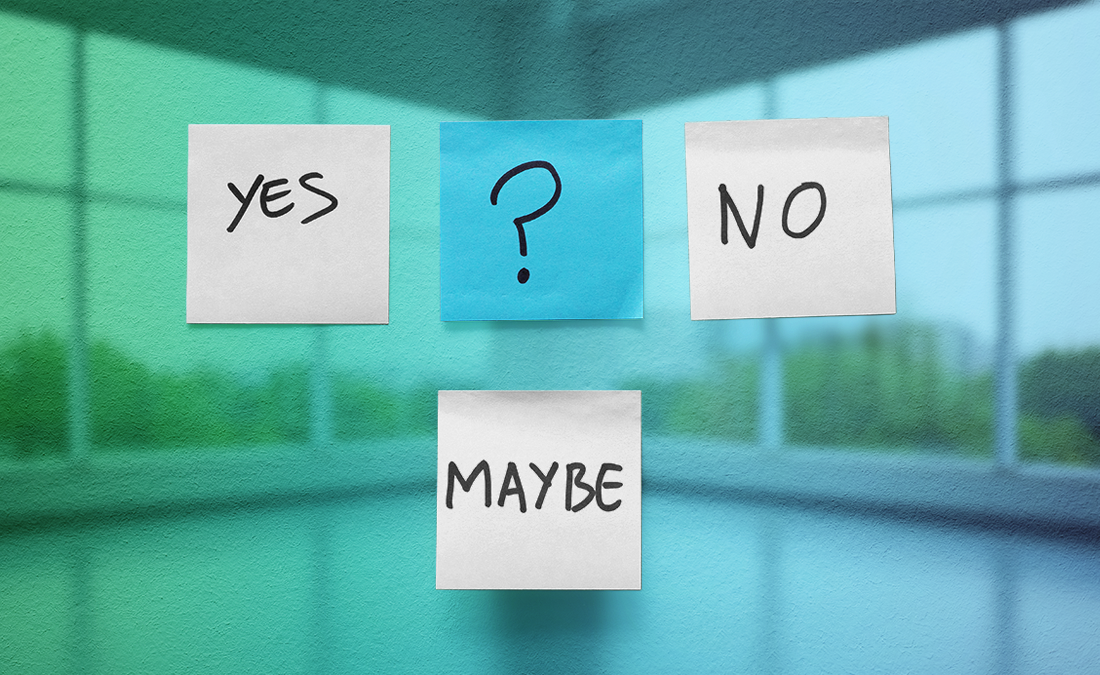
When the answer is yes, it is usually clear.
When the answer is no, it is often immediate.
When the answer is maybe, it almost always means no.
We just do not want to admit it yet.
Indecision rarely comes from a lack of information. More often, it comes from a quiet internal disagreement. One part of you already knows the answer. Another part is trying to negotiate around it.
That negotiation is where doubt sneaks in.
Golf makes this obvious.
Good golfers do not stand over the ball thinking about where not to hit it. The moment the thought becomes do not hit it in the water, the ball is already headed there.
Instead, they pick a spot. A leaf. A blade of grass. They focus on where they want the ball to go.
Aim small. Miss small.
Good golfers also have a routine.
They step back.
Choose a club.
Line up the shot from behind the ball.
Take the same number of practice swings.
Set their feet.
Breathe.
The routine is not about mechanics. It is about settling the mind. It keeps attention on the process instead of the outcome and blocks out the internal commentary that leads to doubt.
When the routine gets rushed, or skipped altogether, it is usually a sign something else has crept in. Urgency. Fear. Second guessing.
The same mental game shows up everywhere.
In baseball, I developed a pre at bat routine long before I ever thought about psychology or performance. No books. No theory. Just habit.
Some of it was probably absorbed from watching hitters from the same era. Players like Roberto Clemente, Carl Yastrzemski, and Johnny Callison. Different personalities, but a similar presence in the box. Calm. Deliberate. Nothing rushed. Nothing wasted.
My routine went like this.
I would step out of the batter’s box.
Finger to my lip.
Then to a specific spot on the bat, where I wanted to make contact.
I would step down the third base line and touch the same spot on the line with each foot.
Back into the box.
Two swings.
And then I was ready.
Quietly locked in on the spot I wanted to hit the ball to, based on the fielders’ positions.
Every at bat.
Every pitch.
From about age eleven until I stopped playing in my mid-thirties.
To this day, if I pick up a bat, I still do it by instinct.
It was not superstition. It was focus. A way to clear noise, eliminate self-doubt, and trust what repetition had already built.
I also picked up a lot from golf instruction influenced by Lanny Bassham, who won an Olympic medal in precision shooting.
One of his observations always stuck with me. If you hit the bullseye 99 times out of 100, all you remember is the one miss.
That is how the mind works. It fixates on failure, even when success is overwhelmingly the norm. And once that fixation creeps in, behavior changes. You stop executing and start protecting.
That same dynamic shows up when people make decisions.
In our profession, there is a natural tendency to slow decisions down. To seek confirmation. To make sure conclusions are well supported and defensible.
That discipline matters. But sometimes it turns into paralysis by over analysis. Decisions stall not because the answer is unclear, but because hesitation feels safer than commitment.
There is another pattern I see regularly.
People will sometimes do things personally that they would never advise a client to do.
Not because they do not know better, but because the situation gets framed as exceptional. A rare opportunity. Something that feels urgent or unique.
That framing has a way of overriding both plans and instincts. People begin rationalizing decisions they already feel uneasy about.
Sometimes breaking a plan is the right move. New information matters. Circumstances change.
But those moments usually feel different. They are calm. Measured. Intentional.
When a decision requires a lot of explaining, especially to yourself, that is usually a signal worth paying attention to.
Plans exist to keep us focused.
Routines exist to quiet the noise.
Instincts exist to keep us honest.
Seeing the whole field means knowing where to aim your attention. It means recognizing when hesitation is actually clarity trying to surface and when overthinking is just the mind remembering the one miss instead of the ninety-nine times you got it right.
Yes, is yes.
No is no.
And maybe is usually no.